

I’ll be honest.
Most people don’t spend much time thinking about fire safety doors & commercial doors.
In fact, if you ask a building owner what upgrades they’ve made recently, they’ll probably talk about new equipment, security systems, fresh paint, or maybe an office remodel. Doors rarely make the list.
I remember visiting a warehouse owner a while back who had invested heavily in improving his facility. We spent nearly an hour walking through the property. He proudly showed me upgraded lighting, renovated work areas, and a brand-new loading setup.
Then, as we were heading back toward the front office, he tapped a steel door with his hand and said something that stuck with me.
“If this building ever catches fire, that door might end up being more important than everything else we looked at today.”
In the context of safety, having quality Fire Safety Doors can make a significant difference in protecting lives and property.
At the time, it seemed like an odd thing to say.
The more I thought about it, though, the more I realized he was right.
Why the Difference Matters
Most commercial doors are built to handle daily business activities. People come and go. Deliveries arrive. Employees move equipment from one room to another.
The door opens.
The door closes.
Nobody thinks twice about it.
And honestly, that’s exactly how it should be.
A standard commercial door is designed for everyday use.
But emergencies change the conversation.
The question suddenly becomes less about convenience and more about protection.
Something I Think Many Owners Overlook
I’ve met plenty of business owners over the years. Most are incredibly focused on protecting their investment.
They insure their property.
They install cameras.
They maintain expensive equipment.
Yet many have never really looked at the doors separating critical areas of their building.
It’s not because they’re careless.
Running a business is demanding. You’re dealing with employees, customers, budgets, deadlines, and a hundred other things every day.
Some building components simply fade into the background.
Until they don’t.
That’s where Fire Safety Doors become important. Their purpose isn’t to impress visitors or improve curb appeal. They’re there to help contain fire and smoke when every second matters.
Nobody buys one hoping they’ll need it.
In fact, most owners hope those doors never have to prove their value.
The Reality of Fire Emergencies
One facility manager told me about a small fire that started in an electrical room years ago.
The fire itself wasn’t massive.
What surprised everyone was how quickly the smoke spread beyond the area where the problem started.
That’s something many people don’t fully appreciate.
When we imagine a fire, we usually picture flames. Smoke often gets overlooked, even though it can travel through a building much faster than people expect.
A properly rated fire door helps slow that spread and creates valuable time for evacuation and emergency response.
And sometimes, a few extra minutes can make all the difference.
Business Doesn’t Stop for Safety Alone
Of course, commercial buildings aren’t only concerned with emergencies.
Most facilities focus on keeping operations running efficiently every day.
If you’ve ever watched a busy warehouse during peak hours, you’ve probably seen how easily small delays create larger ones.
A forklift waits.
A shipment gets held up.
Employees lose a little time moving between work areas.
None of these things seems significant on its own.
Together, they can impact productivity.
That’s one reason businesses often install high-speed doors in areas where traffic flow matters. The goal isn’t necessarily safety. It’s keeping people, products, and equipment moving without unnecessary interruptions.
For companies processing hundreds of deliveries or movements every day, those seconds add up surprisingly fast.
Which Door Is Better?
I don’t really think one is “better.”
They’re designed for different purposes.
It’s a bit like comparing work boots to a hard hat.
If you’re on a construction site, you probably need both.
The same idea applies to commercial facilities.
Different areas have different requirements. A loading dock doesn’t serve the same purpose as a stairwell. A storage room isn’t used the same way as a shipping area.
The smartest solution is usually matching the door to the job.
Final Thoughts
The older I get, the more I appreciate things that quietly do their job without drawing attention.
Commercial doors fall into that category.
Nobody posts photos of them on social media.
Customers rarely notice them.
Employees walk past them every day without giving them a second thought.
Yet these are often the same features that help protect people, support operations, and reduce risk when something unexpected happens.
Maybe that’s why that warehouse owner’s comment stayed with me all these years.
Some of the most important investments in a building aren’t the ones that get noticed every day.
They’re the ones that are there when you need them most.
FAQS
FAQ 1: Do fire-rated doors look different from regular commercial doors?
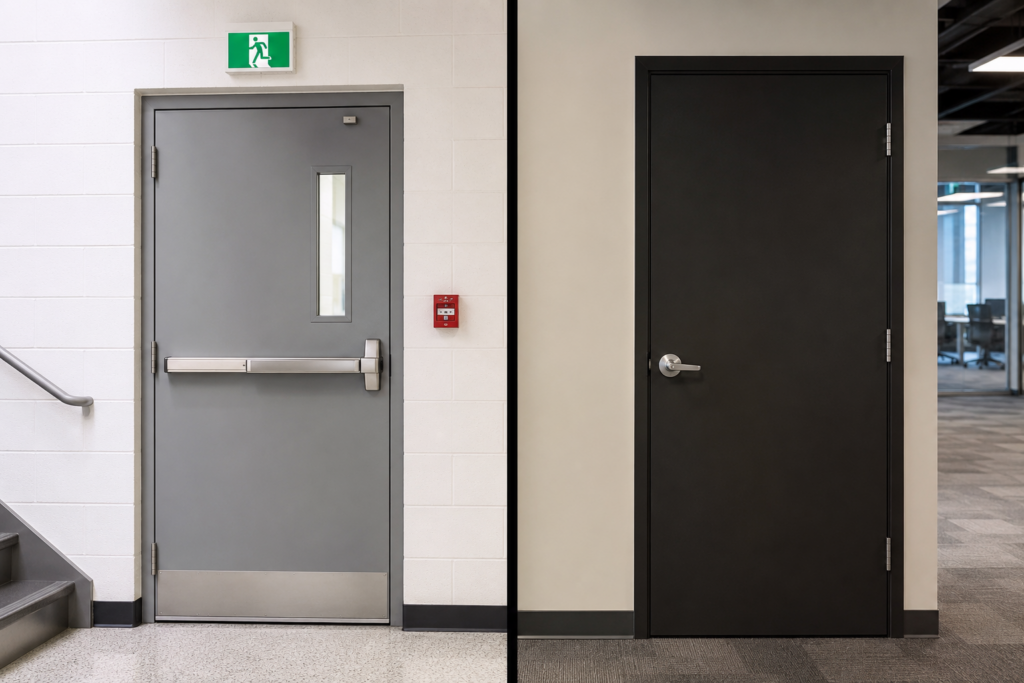
Not always. In many cases, a fire-rated door looks very similar to a standard commercial door. The real difference is in how it’s built and tested. What matters isn’t how the door looks but how it performs during a fire emergency.
FAQ 2: Are fire-rated doors required in every commercial building?
Not necessarily. Requirements depend on the building’s layout, occupancy type, and local fire codes. Some areas, such as stairwells, utility rooms, and exit corridors, are more likely to require fire-rated protection than others.
FAQ 3: How long can a fire-rated door resist fire?
That depends on its rating. Some doors are designed to withstand fire for 20 minutes, while others may provide protection for 60, 90, or even 180 minutes. The appropriate rating depends on where the door is installed and the building’s safety requirements.
FAQ 4: Can a damaged fire-rated door still provide protection?
Even minor damage can affect how a fire-rated door performs. Dents, missing hardware, damaged seals, or improper modifications should be inspected as soon as possible to ensure the door remains compliant and functional.
FAQ 5: Why do warehouses often use high-speed doors?
Warehouses are busy environments where efficiency matters. High-speed doors help reduce waiting times, improve traffic flow, and minimize energy loss by opening and closing much faster than traditional commercial doors. This can make daily operations smoother and more productive.